.svg)

By Cindy Orias and Theo D'Souza
But in practice, Data Governance initiatives often struggle not because of missing tools or policies but because they require changes in how people work with data every day.
Data Governance introduces new expectations around:
These are not just structural changes, these shifts require behavioural change across teams, which is where change management principles become essential.
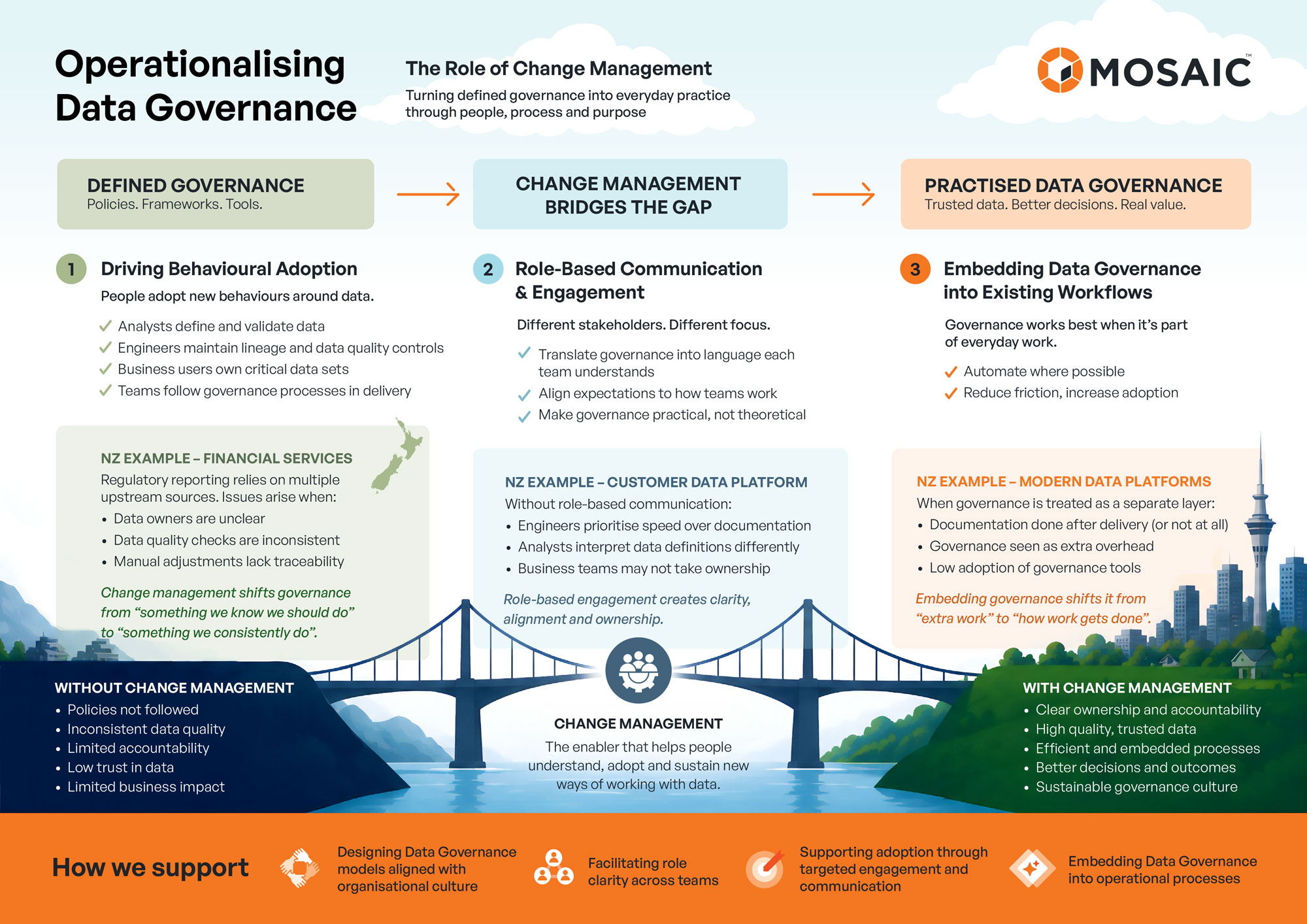
Click image to enlarge
Data Governance requires people across the organisation to adopt new behaviours around data.
This includes:
From a change perspective, this requires more than awareness. It requires:
Change management helps organisations move from awareness of Data Governance to actual behaviour change. In many financial institutions, regulatory reporting often relies on multiple upstream data sources.
Even where Data Governance frameworks exist, issues still arise when:
The challenge is not the absence of policy but the inconsistent adoption of governance behaviours in day-to-day work. Change management helps bridge this gap by shifting governance from “something we know we should do” to “something we consistently do.”
Data governance affects many different stakeholders across an organisation (engineers, analysts, business teams, and risk functions). A common challenge is that governance initiatives communicate at a generic organisational level, which can make expectations unclear. Change management emphasises role-based engagement, ensuring governance is translated into language that different teams understand. Consider an organisation implementing a new customer data platform.
Without role-based communication:
The result is fragmentation – despite having governance structures in place.
With role-based engagement:
Data Governance becomes sustainable when it integrates into activities teams already perform. One of the most effective change strategies is to embed new practices into existing workflows, rather than introducing entirely separate processes. In many organisations even with the use of modern stack platforms, data governance is often treated as a separate layer.
This leads to:
However, when governance is embedded:
Data Governance then shifts from “extra work” to “how work gets done.”
Supporting organisations in data governance is not only about designing frameworks or implementing tools. It also involves helping organisations manage the organisational change required to operationalise Data Governance. Data governance doesn’t fail because organisations lack frameworks. It struggles when organisations underestimate the behavioural change required. Applying change management principles alongside governance helps move from Defined Governance to Practised Data Governance.
And that’s where real value starts.
If you are looking for more information on how you can support your people through your transformation initiatives this year, Mosaic would be thrilled to get in touch.

By Cindy Orias and Theo D'Souza
But in practice, Data Governance initiatives often struggle not because of missing tools or policies but because they require changes in how people work with data every day.
Data Governance introduces new expectations around:
These are not just structural changes, these shifts require behavioural change across teams, which is where change management principles become essential.