.svg)

By Theo D’Souza and Gauri Hopkins
Most of us have been part of a change initiative that started with real energy. A compelling vision. A leadership team aligned. Genuine excitement in the room. And then, somewhere between the launch event and go-live, it quietly fell apart.
Not because the ‘why’ wasn’t good enough. Because nobody had a plan for the ‘why not.’ In this article, we’re getting into the stories quietly killing your change initiatives, and the key to addressing them.
Change initiatives usually open the same way. A new strategy, system, or way of working arrives to move the organisation from where it is to somewhere better. Improved performance. Stronger culture. Greater flexibility. A more sustainable future.
In the corporate version, this becomes the language of transformation: not “we’re moving to hotdesking,” but “we’re enabling flexibility and collaboration.” Not “we’re replacing systems,” but “we’re improving efficiency and creating better employee experiences.”
The hero story matters because it gives people something to move toward. It connects rational business goals with emotional purpose1. That’s a story worth telling, and a reason worth changing for.
But every good story has a villain. And in most change initiatives, nobody’s writing that script.
The ‘why not’ rarely announces its arrival. It doesn’t show up in the launch event or the communications deck. It simmers quietly in the background, until it hits boiling point.
The first sign is usually fear-driven rumours. Perhaps one of our heroes was a misunderstood character, or part of a failed project in the past. The story spreads, and no one wants to internalise something or someone that feels infected. The outcome: hesitation.
Then the bigger voices enter. A leader who believes people work better with predictability, a set desk, a known routine. Another who sees new technology as money down the drain for an "older" demographic, quietly recruiting allies to stand down implementation. Suddenly staff are forced to pick a side. The outcome: a divisive culture.
And then there are those stubborn structural blind spots. Change teams may follow a rigid pre-planned process² e.g., “a PM does this, a CM does that, a BPO makes the decisions, readiness comes at the end.” The problem? Templates are inflexible and change is not. The outcome: gaps, lost staff, and failed initiatives.
We don’t have to look far for evidence. A quick search of “Change Management” on LinkedIn tells the “Why Not” story well.
Essing puts it plainly: “Change is messy, relational and stubbornly human”. Frameworks like ADKAR and Agile have their place, but treating them as complete solutions misses the trust, habits and human connection that actually sustain change beyond the initial rollout.³
Reader goes further, identifying what he calls “work avoidance”: the tendency of leaders to deflect adaptive challenges back toward technical fixes. Most initiatives don’t fail because the plan is wrong. They fail because the human dimensions of identity, loss, and belief were never addressed at all.⁴
Khokhar developed the Organisational Change Breaking Point Theory to explain what happens when organisations ignore that work. A “Breaking Point Zone” of resistance, confusion, and collapse. His prescription is simple: align first, then execute, rather than implementing change and trying to fix the human story later.⁵
Chandra cuts to the chase: change gets you live, capability keeps you running, and proficiency makes you exceptional. Everything before go-live is preparation. The real work comes after.⁶
If you've ever watched a brilliant initiative die a slow death in a meeting room, you've seen the "why not” to change stories at work. It rarely announces itself. It just chips away.
These are precisely the “why nots” quietly undermining the purposeful “whys” change teams are often busy telling everyone about.
So, if the problem lives inside the people, then that’s where the solution has to start.
Here’s the reframe most change programs miss.
The battle between ‘why’ and ‘why not’ isn’t won in the rollout plan or the communications deck. It’s won or lost inside the people you’re asking to change.
So, the key? See all transformation initiatives as an internal process first.
In 2025, Kamarova et al. identified a critical gap: existing organisational change models told practitioners what to do, but not why it works. Their answer was the Integrated Model of Organisational Change (IMOC), a framework that connects change practice to the psychological mechanisms that determine whether people genuinely adopt and sustain change. Their core argument? It comes down to three psychological needs:
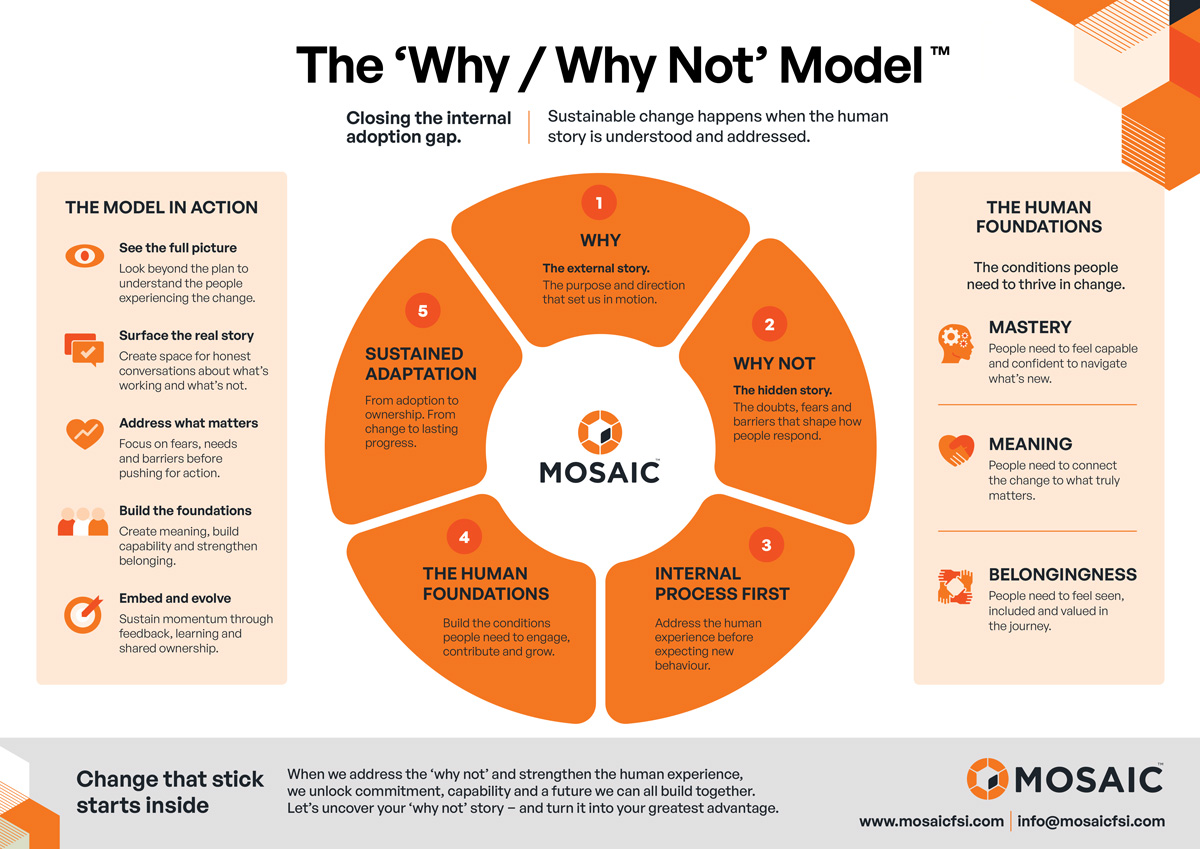
These aren’t soft ideals. They’re activated by 26 evidence-based practices mapped across five stages of organisational change. And these aren’t big interventions. They’re the difference between a change that lands and one that quietly gets worked around.
Think about the last change initiative you were part of not the one on the slide deck, the real one. Did people feel they were growing through it, or just surviving it? Did they understand why it mattered to them, not just to the business? Did they feel they had a place in what came next?
The ‘why not’ is a patient villain. It doesn’t need your help. It will find the gaps, recruit the doubters, and outlast the launch event every time unless you meet it head on. That’s not a failure of strategy. It’s a failure of attention.
Mastery, meaning, and belongingness aren’t the soft stuff. They’re how the hero story wins.
You already have the ‘why.’ Now it’s time to confront the ‘why not’ before it writes the ending for you.
If your change initiative has a ‘why not’ story you haven’t faced yet, we can help you find it and change that.
.jpg)
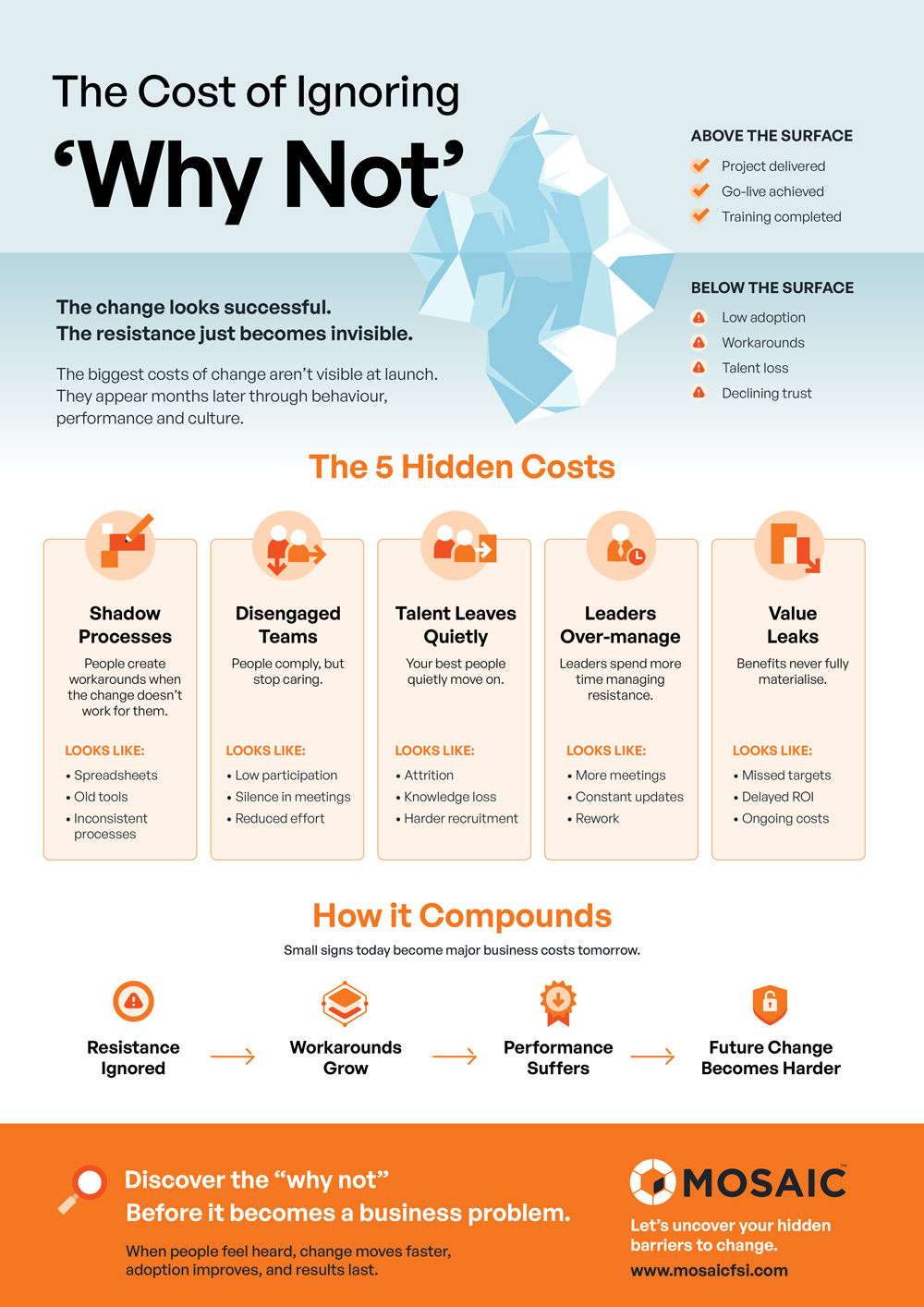
The Cost of Ignoring ‘Why Not’ (PDF)
The ‘Why / Why Not’ model (PDF)
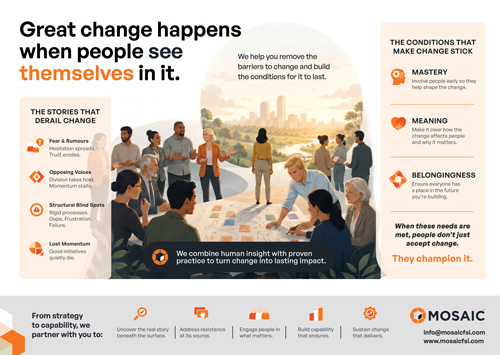
Great Change Happens When People Can See Themselves in it (PDF)
References
By Theo D’Souza and Gauri Hopkins
Most of us have been part of a change initiative that started with real energy. A compelling vision. A leadership team aligned. Genuine excitement in the room. And then, somewhere between the launch event and go-live, it quietly fell apart.
Not because the ‘why’ wasn’t good enough. Because nobody had a plan for the ‘why not.’ In this article, we’re getting into the stories quietly killing your change initiatives, and the key to addressing them.
Change initiatives usually open the same way. A new strategy, system, or way of working arrives to move the organisation from where it is to somewhere better. Improved performance. Stronger culture. Greater flexibility. A more sustainable future.
In the corporate version, this becomes the language of transformation: not “we’re moving to hotdesking,” but “we’re enabling flexibility and collaboration.” Not “we’re replacing systems,” but “we’re improving efficiency and creating better employee experiences.”
The hero story matters because it gives people something to move toward. It connects rational business goals with emotional purpose1. That’s a story worth telling, and a reason worth changing for.
But every good story has a villain. And in most change initiatives, nobody’s writing that script.
The ‘why not’ rarely announces its arrival. It doesn’t show up in the launch event or the communications deck. It simmers quietly in the background, until it hits boiling point.
The first sign is usually fear-driven rumours. Perhaps one of our heroes was a misunderstood character, or part of a failed project in the past. The story spreads, and no one wants to internalise something or someone that feels infected. The outcome: hesitation.
Then the bigger voices enter. A leader who believes people work better with predictability, a set desk, a known routine. Another who sees new technology as money down the drain for an "older" demographic, quietly recruiting allies to stand down implementation. Suddenly staff are forced to pick a side. The outcome: a divisive culture.
And then there are those stubborn structural blind spots. Change teams may follow a rigid pre-planned process² e.g., “a PM does this, a CM does that, a BPO makes the decisions, readiness comes at the end.” The problem? Templates are inflexible and change is not. The outcome: gaps, lost staff, and failed initiatives.
We don’t have to look far for evidence. A quick search of “Change Management” on LinkedIn tells the “Why Not” story well.
Essing puts it plainly: “Change is messy, relational and stubbornly human”. Frameworks like ADKAR and Agile have their place, but treating them as complete solutions misses the trust, habits and human connection that actually sustain change beyond the initial rollout.³
Reader goes further, identifying what he calls “work avoidance”: the tendency of leaders to deflect adaptive challenges back toward technical fixes. Most initiatives don’t fail because the plan is wrong. They fail because the human dimensions of identity, loss, and belief were never addressed at all.⁴
Khokhar developed the Organisational Change Breaking Point Theory to explain what happens when organisations ignore that work. A “Breaking Point Zone” of resistance, confusion, and collapse. His prescription is simple: align first, then execute, rather than implementing change and trying to fix the human story later.⁵
Chandra cuts to the chase: change gets you live, capability keeps you running, and proficiency makes you exceptional. Everything before go-live is preparation. The real work comes after.⁶
If you've ever watched a brilliant initiative die a slow death in a meeting room, you've seen the "why not” to change stories at work. It rarely announces itself. It just chips away.
These are precisely the “why nots” quietly undermining the purposeful “whys” change teams are often busy telling everyone about.
So, if the problem lives inside the people, then that’s where the solution has to start.